A Comprehensive Guide to Answer Engine Optimization and Brand Identity
The 2026 marketing landscape is defined by a profound paradox: technology has never been more advanced, capable of generating infinite content at near-zero cost, yet the human craving for authentic, verified, and emotional connection has never been more profound.
As artificial intelligence (AI) pervades every aspect of digital interaction, from administrative workflows to complex customer service queries, small businesses and creative agencies face a critical challenge: the temptation to rely solely on AI for content production is economically alluring but leads to a “sea of sameness” that erodes the unique brand identities vital for customer loyalty and market differentiation.
While AI is an indispensable tool for data synthesis and workflow acceleration, human-written and designed content remains an essential factor in safeguarding brand integrity. The creative team is no longer just a content producer; it is the guardian of the brand’s soul and the architect of its digital future.
We are witnessing a seismic shift from traditional Search Engine Optimization (SEO) to Answer Engine Optimization (AEO): in this new “Zero-Click” reality, a brand must be an authority that AI trusts enough to cite, and a voice that humans trust enough to follow.

Chapter 1: The Creative Marketing Landscape of 2026
1.1 The Paradox of Automation and Authenticity
The current digital ecosystem has decoupled the volume of content from the value of content. Generative AI has democratized creation, but this accessibility has largely homogenized digital voices. When businesses use the same underlying Large Language Models (LLMs) to draft their brand messaging, the output converges toward a statistically average mean, resulting in content that sounds stale and disingenuous.
Algorithms are inherently designed to predict the most likely next word based on vast datasets of historical text. This probabilistic mechanism favors safe, generic, and widely-used phrasing over the idiosyncratic, bold, or industry-specific language that defines a memorable brand. The result is polished but hollow content that reads grammatically correct on the surface but feels devoid of soul, perspective, or unique relevance to the specific community it intends to serve.
AI cannot spontaneously react to a breaking local news event, a sudden shift in community sentiment, or a real-time cultural moment with the sensitivity of a human observer. Consequently, the brands that rely entirely on these tools for their voice risk becoming invisible; not because they are absent, but because they are indistinguishable.
1.2 The Sociology of Algorithm Fatigue
“Algorithm Fatigue” has become a defining characteristic of the 2026 user experience, defined by the constant overwhelm of content that prioritizes engagement metrics over genuine value. Creative teams provide the emotional weight that keeps a brand grounded in reality.
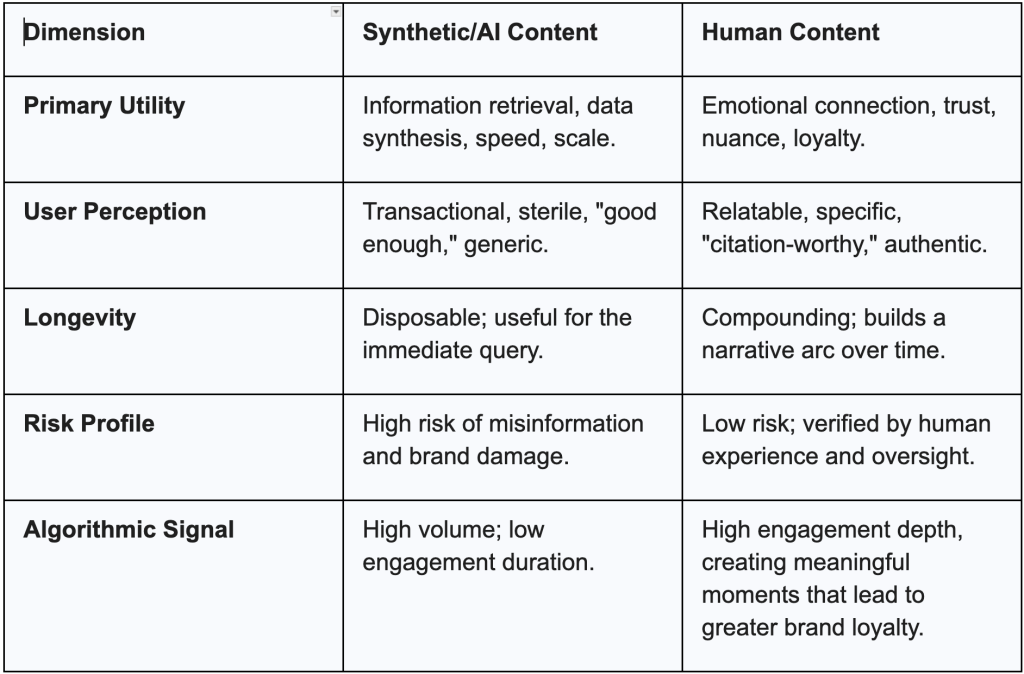
Storytelling is not a single post; it is an arc. Human teams can weave a narrative thread that spans months, referencing milestones, celebrating staff, or commenting on local news.
AI operates transactionally, task by task. It does not inherently “remember” that a client celebrated a 10-year anniversary or won a local award unless explicitly fed that data in a structured way.
Creative teams build a compounding cross-platform narrative arc to build trust and loyalty. When a customer comments on a post and gets a witty, relevant reply (not an automated “Thanks!”), it creates a micro-moment of delight that builds loyalty. This “Human Anchor” is not merely a creative preference; it is a survival strategy in an age where trust is the scarcest resource.
Table 1.1. The Divergence of Content Types in the Trust Economy
Moving from Noise to Knowledge
Why does understanding this landscape matter? Because algorithm fatigue is fundamentally changing how users look for information.
People no longer want to sift through ten pages of hollow content; they want immediate, trusted answers. This behavioral exhaustion is the exact catalyst driving the overhaul of how data is structured to shift from traditional search engines to AI.

Chapter 2: The Seismic Shift from SEO to AEO
2.1 The Regression of the Blue Link
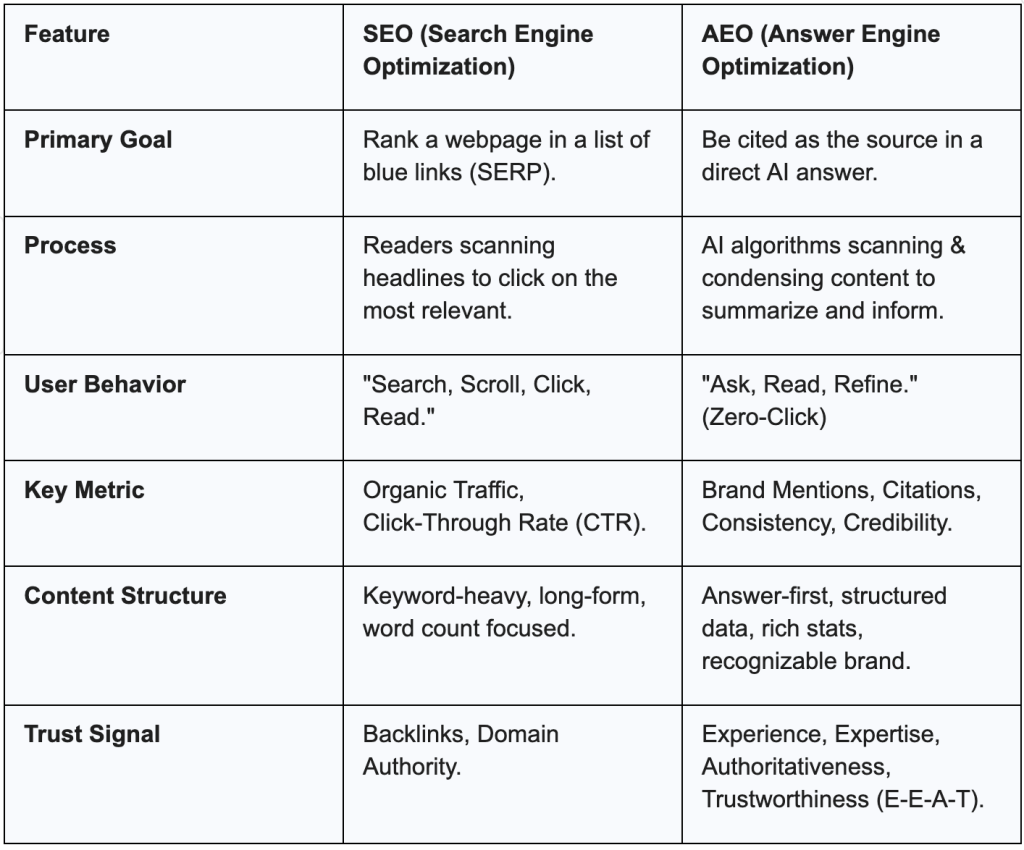
For two decades, marketing success was measured by the ability to rank a webpage in a list of blue links on a Search Engine Results Page (SERP). The user behavior model was linear: “Search, Scroll, Click, Read.” This model is rapidly waning as search evolves into Answer Engine Optimization.
AI platforms do not just index the web; they synthesize it. The new user behavior model is “Ask, Read, Refine.” In this paradigm, the user may never actually even visit the source website: instead, the AI provides a direct answer to the question being asked.
Table 2.1 SEO vs. AEO Comparison
2.2 The Zero-Click Reality
By early 2026, nearly 60% of all Google searches globally ended without a single click to a website. This behavior is even more pronounced on mobile devices, where screen real estate is limited and users seek immediate gratification.
Being on page one of Google is no longer enough; the brand must be embedded in the AI’s “knowledge graph” as a trusted entity. The goal has shifted from driving traffic to driving influence and citations.
AI models are trained to seek consensus across multiple trusted sources. If a brand’s hours, services, or core value propositions are inconsistent across platforms (website, social, directories), the AI is less likely to cite the brand as a definitive source.
2.3 The Mechanics of AEO: How to Be Cited
To be cited by an AI platform, content must be “machine-readable” and authoritative. This involves optimizing for Retrieval Augmented Generation (RAG), where the AI retrieves external data to ground its answers, such as:
- Entity-First Strategy: AI understands “entities” (people, places, things, concepts) and the relationships between them. A business must establish itself as a clear, unambiguous entity in the digital space. This is achieved through consistent Name, Address, and Phone (NAP) data, robust “About Us” pages, and presence in authoritative directories.
- Bridging the Retrieval Gap: The “Retrieval Gap” occurs when an AI system misses relevant context because it is buried in unstructured text or lacks semantic clarity. To bridge this gap, content must be structured clearly, using headings that match natural questions.
- Schema Markup: This is the code that translates human content into machine-readable data. Implementing robust schema (Organization, LocalBusiness, FAQPage, Person) helps AI understand the context of the content beyond simple text.
Crafting the Creative Counterweight
Why do we need a new creative framework if AEO is largely technical? Because once the machine finds you and cites you, the human user has to believe you.
If the AI serves a sterile, generic answer attributed to your brand, you win the algorithmic battle but lose the human connection. To convert visibility into impact, we must root our technical strategies in deep, human authenticity.

Chapter 3: The Human Anchor Framework
The “Human Anchor Framework” is built around the philosophy of genuine human connection as a brand’s most powerful differentiator and the ultimate driver of consumer trust.
By deliberately anchoring your marketing in real human experiences, you bridge the gap between algorithmic visibility and authentic audience loyalty.
3.1 Auditing and Humanizing Brand Voice
In an era where AI can generate passable marketing copy in seconds, the specific voice of a brand becomes its primary asset. This involves a review of all digital touchpoints — from the high-visibility “About Us” page to the often-overlooked automated email responses and ad copy.
Actionable Strategy: The “Three Adjectives” Exercise
Define three words your brand is (e.g., Witty, Compassionate, Gritty) and three words it is not (e.g., Corporate, Silly, Aggressive). This establishes the “training data” for any internal content creation and ensures consistency across platforms. This specific tonal calibration is difficult for generic LLMs to maintain over long periods without human oversight.
3.2 “Answer-First” Content Creation
The structure of content is just as important as the substance. An “Answer-First” methodology inverts the traditional blog post structure. Instead of burying the lead after a long introduction, the content offers the answer immediately.
Implementation Steps:
- Identify Queries: Identify the top 10 questions customers ask during phone calls or consultations. These are high-intent, long-tail queries.
- Direct Answer: The content should begin with a concise, direct response to a question optimized for AI retrieval systems to lift and display as the answer.
- Elaboration: Following the direct answer, the content should expand with personal stories, case studies, and nuance that only an industry expert can provide.
- Benefit: This structure simultaneously serves the AI (providing the direct answer for citation) and the human reader (providing depth and connection).
3.3 Visual Storytelling as High-Bandwidth Emotion
Video content is high-bandwidth for emotion. It conveys tone, sincerity, and personality in a way that text alone cannot. Search engines and AI models are becoming increasingly more multimodal with each update, indexing video content to answer common inquiries.
Recommended Assets for Authenticity:
- B-Roll Libraries: Footage of real people working and interacting with clients.
- “Day in the Life” Reels: Unscripted, transparent behind-the-scenes content.
- Founder/Team Speak: Direct-to-camera addresses that humanize the business.
- Verification: Visuals serve as a verification layer. A video of a team member explaining a service adds a layer of trust that text generated by an LLM cannot.
- Listening vs. Broadcasting: Human teams use social listening to hear what the community is talking about — fears, trends, local news — and adapt the content strategy accordingly. This responsiveness creates a “living” brand that feels far more vital than a static, AI-managed presence.
Adding Foundation to the Framework
Why isn’t a great story compelling enough on its own to verify your brand? Because AI cannot understand and retrieve data from well-written or well-designed content alone.
The Human Anchor Framework gives your brand its soul, but to scale that soul across the digital landscape, we must build a technical architecture that AI knows to source.

Chapter 4: Technical Architecture of Authority
AEO is a structural approach to digital marketing where every piece of your online presence is deliberately tethered to a verifiable expert, location, or tangible real-world footprint.
To transform your business into a definitive entity that AI models confidently cite, you must build an infrastructure that translates human authenticity into machine-readable proof through schema markups and retrieval gap optimization.
4.1 Schema Markup: The Language of AI
To communicate effectively with Answer Engines, brands must speak their language. Schema markup (JSON-LD) is the code that helps AI understand the meaning of content, not just the text characters. It is the metadata that transforms a string of words into a structured entity.
Essential Schema Types for Small Business AEO:
- LocalBusiness Schema: Critical for local visibility. It must include accurate NAP (Name, Address, Phone), hours, service area, and links to social media to confirm identity.
- FAQPage Schema: This schema type directly formats questions and answers for AI retrieval. It allows an AI to parse the question and the answer distinctly, increasing the likelihood of citation.
- Person Schema: Connects content to a specific human expert. This boosts E-E-A-T by verifying that a real person with credentials stands behind the advice.
- Review Schema: Aggregates social proof, allowing AI to cite reviews directly.
4.2 Optimizing for the “Retrieval Gap”
AEO requires bridging the “Retrieval Gap”— the disconnect between what a user asks and how an AI model retrieves information. AI models use vector embeddings to find semantic relationships, but they can miss context if the “semantic distance” is too great.
- Semantic Closeness: Use the exact language customers use.
- Data Density: AI models prefer content rich in facts and statistics. Rather than fluffy adjectives (“we provide excellent service”) use quantifiable data (“we have served 500+ clients in Whatcom County since 2010”).
- Formatting: Use bullet points, bold text for key answers, and provide clear H2/H3 headers. This allows AI to efficiently extract relevant information.
- Consistency: The AI must see the same business name, address, and description across search engines and industry directories. Inconsistencies cause the AI to “distrust” data.
- Consensus: The AI looks for consensus on what the business does. If the website says “Plumbing” but Yelp says “HVAC,” the entity definition is weakened.
- Citations: Mentions in authoritative, third-party sources (news, industry blogs, etc.) serve as validation. The goal is to build a “digital footprint” that proves the business exists and is significant to its community.
Developing AEO-Rich Content
Why go through the process of marking up data and ensuring perfect entity consistency? Because every accurate data point and verified citation is a deposit into your brand’s trust bank.
In a digital world plagued by skepticism and synthetic content, trust isn’t just a metric — it is the entire economy.

Chapter 5: The Trust Economy & Deep Engagement
5.1 Trust as the New Currency
Trust is one of the most challenging performance metrics for marketers. Consumers are skeptical of “synthetic messaging” and actively look for proof of humanity.
Trust is not given; it is earned through verification and consistency. By contributing to the digital ecosystem with accurate, structured, and consistent information, businesses reduce the probability of an AI platform inventing false details.
5.2 Deep Engagement Strategies
Engagement is the heartbeat of the Human Anchor strategy. Allocating time for genuine interaction, building a localized community ecosystem, and offering highly personalized replies validates your brand in a way AI cannot:
- 15-30 Minute Daily Interaction: Brands should allocate specific time each day for genuine interaction — not just posting, but commenting on partners’ posts and answering questions in local groups.
- Community Ecosystem: Building an ecosystem of trust involves interacting with other local businesses. This creates a network of local entities that validates location and community standing to the search algorithms.
- Personalized Replies: When a user takes the time to comment, a personalized reply validates their effort in a retention strategy that AI is unable to replicate.
Preparing for What’s Next
Why build this deep, localized trust? Because by cementing your brand as a trusted, human-anchored entity today, you set yourself up for the pre-established trust of tomorrow’s autonomous agents.

Chapter 6: Future-Proofing Content
6.1 Agentic AI and the Future of Discovery
Looking beyond 2026, the marketing landscape will be shaped by “Agentic AI” — autonomous AI agents that act on behalf of the user to research, plan, and purchase.
In this future, marketing to the machine becomes almost as critical as marketing to the human. Brands will need to already be established as “machine-readable” to be included for consideration amongst these agents.
6.2 The Role of the Creative Team
The responsibility of the creative team evolves from content producers to shift toward:
- Oversight: Reviewing AI outputs for tonal accuracy and factual integrity.
- Humanity: Adding the “witty, specific, vulnerable” elements that AI cannot generate.
- Community Building: Managing the relationships that generate the engagement signals AI algorithms crave.
6.3 Strategic Action Plan
Immediate Actions (Next 30 Days):
- Brand Voice Audit: Review your “About Us” page and social bios. Apply the “Three Adjectives” test.
- Claim and Consistency Check: Audit the business’s presence across major social platforms. Ensure NAP data is identical.
- Review Strategy Update: Implement a process to reply to every review with a personalized message.
Strategic Shifts (Next 90 Days):
- Answer-First Content Pilot: Create 5 dedicated pages using the Answer-First structure (Direct Answer + Story + Data).
- Video Integration: Commit to one founder-led or team-led video per month that directly addresses a community topic.
- Schema Implementation: Implement FAQPage and LocalBusiness schema.
Long-Term Vision (1 Year):
- Build the Narrative Arc: Plan a content calendar that tracks a specific narrative, referencing milestones to build a compounding story.
- Deep Engagement: Establish a daily routine for social listening and engagement.
- AEO Monitoring: Begin tracking “brand mentions” and “share of search” rather than just keyword rankings.

Swell Media Solutions serves as a trusted extension of our clients’ voices, founded on the instrumental principle: clarity drives connection, and connection drives impact.
In a landscape flooded with automated noise, we are dedicated to building marketing systems that empower businesses to communicate with purpose, grow with intention, and lead with confidence. The transition to Answer Engine Optimization is not merely a technical update; it is a fundamental shift in how businesses communicate value in a digital-first world. As AI handles the retrieval of facts, the premium on human connection skyrockets.
By leveraging the efficiency of AEO to be found, and the power of human storytelling to be chosen, small businesses can navigate the Age of AI with their integrity, authority, and personality intact. The future belongs to those who can speak the language of the machines while touching the hearts of the people.
Share
Related Posts